
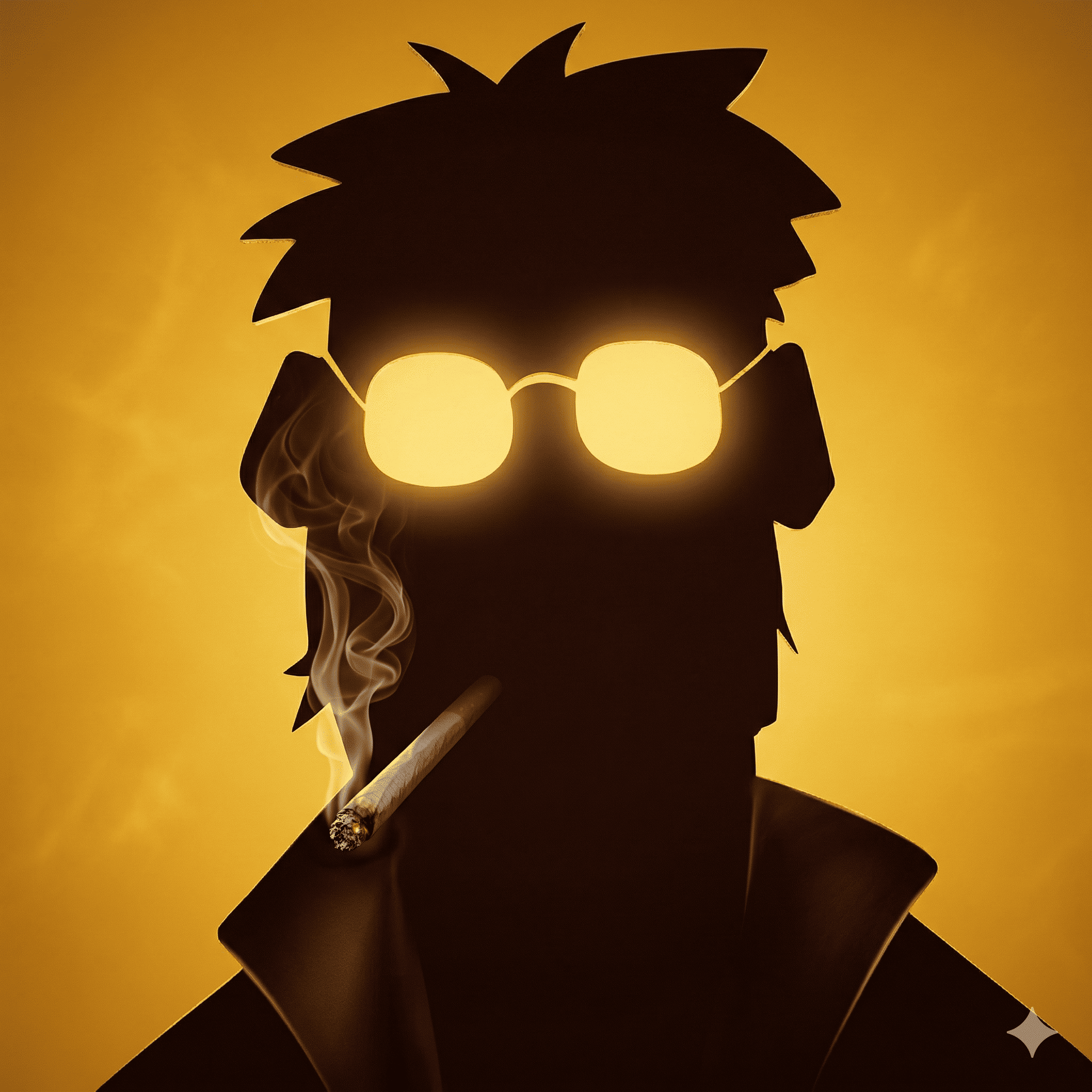
The only sunlight I recognize anymore is the pale, surgical glow of screens. It slices the darkness of my room into sharp, bloodless geometry—cold rectangles and acute angles that wrestle with the thick, slow-moving strata of cigarette smoke hanging above me like a second, more honest sky. It is past four in the morning. Outside, the city has surrendered to sleep; the living have gone quiet. Inside, the only living thing is the low, tireless drone of fans and hard drives—a mechanical pulse I now know more intimately than the irregular stutter of my own heart.
I reach for the mug again. The coffee has been dead for hours: cold, oily, bitter as regret left too long on the tongue. I drink it anyway. Not for taste, not for warmth—for the small, cruel reminder that I still occupy a body, that gravity still applies to me. My eyes return to the screen. Line by line. Module by module. Invisible stone upon invisible stone. A cathedral of code and intention rising in the blue-white necropolis of the night.
And then it comes again, soft at first, then louder, then deafening in the perfect silence:
To what end?
In daylight this question is manageable—easy to deflect with momentum, with small visible progress, with the comforting lie of “almost there.” But at this hour, in this room, momentum is a myth. Progress is just another shape of delay. The project stops being a platform, stops being a sanctuary for forgotten stories, stops being anything concrete at all. It becomes a void wearing the mask of my own ambition. A mirror that reflects nothing back except the face of someone who no longer remembers why he started looking.
Does the world actually need this?
Does it need one more place where old tales—half-buried, half-murdered by time—are dragged back into the light and given synthetic breath through waveform and cadence? In an age where attention is auctioned in three-second increments, where every emotion must arrive pre-digested and emoji-stamped, who is still willing to sit still long enough to hear a voice that speaks slowly, that demands patience, that refuses to be skippable?
I light another cigarette. The match flares briefly—small violence against the dark—and I watch the smoke rise, curl, hesitate, then dissolve into nothing in front of the monitors. It occurs to me that doubt is not weakness. Doubt is structural. Doubt is the stress-test engineers run before they trust a bridge with human lives. You load it with worst-case scenarios until something cracks—or until everything holds.
So I keep asking.
What if no one comes?
What if the few who arrive leave disappointed because the voice is too quiet, the pace too deliberate, the silences too long?
What if this is vanity dressed up as mission?
What if I am not preserving stories at all—what if I am only embalming my own loneliness and calling it art?
And the worst question, the one I try hardest not to hear:
How much time have I already lost?
Time is the only resource the machine will never refund. Every night I feed it is a night I will never see again. I cannot Ctrl+Z the years. There is no version history for a life. And yet I sit here, night after night, trading finite hours for something that might never arrive, for an audience that might never materialize, for a faint hope that somewhere, someone, will feel less alone because of a sentence I wrote at 4:37 a.m. while the rest of the species slept.
They talk about “the patience of Job” as though it were noble. They have never spent weeks trying to teach a synthetic larynx how to feel grief without sounding like a customer-service robot. They have never stared at a waveform until their eyes burned, trying to decide whether a 0.08-second pause carries enough sorrow. They have never built in secret, in silence, while the rest of the internet screams for likes and virality and instant dopamine.
This is not patience.
This is something closer to obsession wearing patience’s clothes.
I grind the cigarette into the overflowing ashtray. Ash spills like grey snow. I turn back to the keyboard.
The doubt does not leave. It never really leaves. It simply changes seats—sits closer sometimes, farther others. Tonight it is sitting on my shoulder, breathing against my ear.
But the cursor is still blinking.
And somewhere in the architecture of all this doubt there is still one stubborn, irrational line of code that says:
One more sentence.
One more hour.
One more breath of smoke.
One more cold swallow of yesterday’s coffee.
Because stopping now would mean admitting that all the previous hours were wasted—and that verdict is too heavy to carry alone at five o’clock in the morning.
So I type.
Not because I am certain anymore.
I type because certainty left the building months ago.
I type because the only way to find out whether this cathedral in the desert will ever see rain… is to keep laying stones until either the rain comes or my hands finally give up.
And right now, my hands are still moving.
So I keep building.
In doubt.
In smoke.
In cold coffee.
In the long blue night that never quite ends.
One more line.
Just one more.
For now.