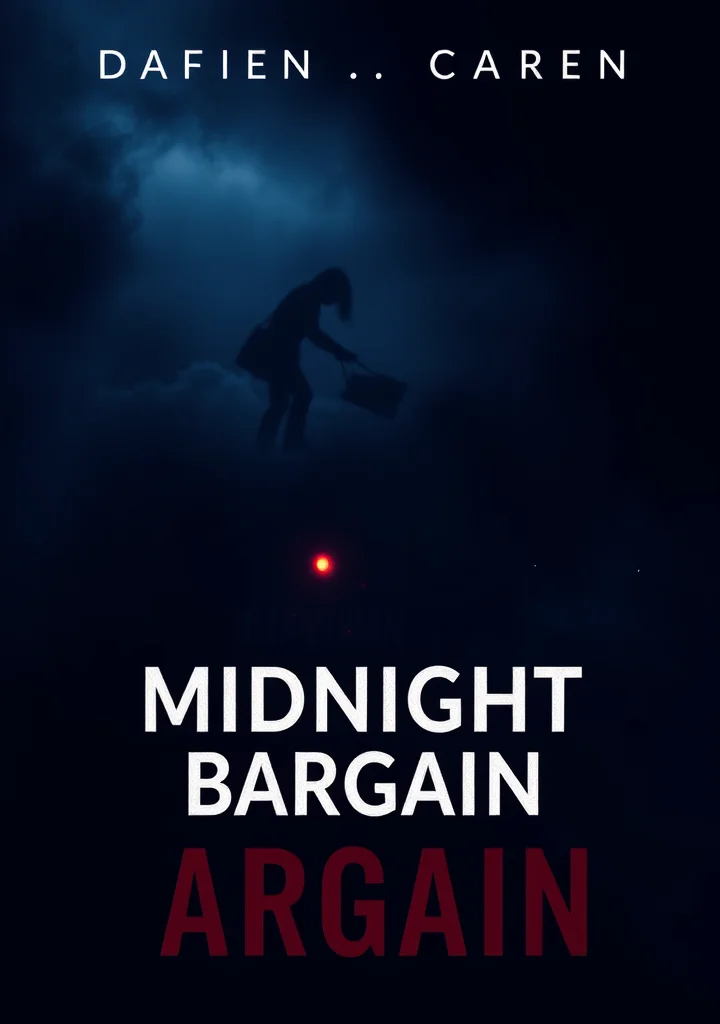
Midnight Bargain
  • 32
  • 0
  • 5
  • Read 32
  • 0
  • Part 5
Completed, First published May 09, 2026

This novel opens onto a world of escalating pressures, where a narrator finds themselves bound to a shadowy, controlling figure. Meanwhile, in present-day New York City, the story introduces Peter Parker, now a successful businessman, alongside Tony Stark and a cast of characters navigating ambition, family obligation, and hidden debts. The narrative traces the desperate struggle of a student supporting her brother, facing mounting financial hardship and a jeopardized scholarship. As a tense birthday encounter unfolds, secrets and lies threaten to unravel already strained relationships, hinting at a dangerous bargain on the horizon.
Copyright: All Rights Reserved
No person is allowed to use, redistribute, or modify your work in any form without your explicit permission.
Recommended for you
33 Part
A creeping dread descends from the Parisian rooftops, clinging to the gaslit alleys like a phantom’s breath. Fantômas is not merely a criminal, but a negation—a void carved into the heart of the city, reflecting back its deepest fears. The narrative coils around a relentless pursuit, a dance between law and shadow where the hunter becomes the hunted, and the line between reality and nightmare dissolves with each stolen jewel and whispered accusation. The atmosphere is one of suffocating elegance, a world of opulent salons and labyrinthine sewers, all shadowed by the looming specter of a man who *isn’t* a man. Every act of defiance, every audacious theft, is performed with a theatrical flourish, leaving behind not evidence, but an unsettling echo of impossible physics. The story bleeds into a fever dream of disguises, identities fracturing under the weight of obsession. A relentless, suffocating paranoia permeates every page. The reader is drawn into a vortex of shifting loyalties, where even the most trusted allies harbor the scent of decay. The true horror isn’t what Fantômas *does*, but the unsettling realization that he embodies the chaos lurking beneath the veneer of order, a darkness that threatens to consume the very foundations of civilization. It is a chase not for a criminal, but for the reflection of a city’s soul, and the chase will leave you breathless, haunted by the certainty that Fantômas is always already *everywhere*.
70 Part
Dust motes dance in the shadowed halls of memory, each recollection a chipped fragment of granite pulled from the bedrock of a life forged in iron. Though ostensibly a chronicle of command and strategy, Grant’s memoir bleeds with the chill of ambition’s long winters. It is not the roar of battle that lingers most keenly, but the hushed silences between orders, the spectral weight of responsibility pressing down upon a man who navigated not glory, but the grey expanse of consequence. The prose itself is a slow, deliberate march through the fog of recollection, each sentence a measured step toward a darkness masked as pragmatism. A relentless current of self-assessment, it leaves one shivering not from cold, but from the awareness of how easily a man can be hollowed out by the very wars he wages. The victories feel less like triumphs and more like the echoing emptiness within a fortress built upon the bones of the fallen. There is a peculiar, unnerving detachment – a dispassionate inventory of ruin that hints at a man already halfway to the grave, cataloging his life as if it were merely another terrain to be mapped and conquered. The very act of remembering feels like a haunting, a spectral revisiting of the fields stained crimson with the harvest of his deeds. The weight of the Union, the weight of failure, the weight of a man who, even in his self-reckoning, cannot quite escape the shadow of his own making. It is a memoir written not from triumph, but from the precipice of oblivion, and the echo of its pages is a long, cold draught from a forgotten tomb.
26 Part
A creeping mist clings to the painted lawns of Ozma’s kingdom, a land perpetually twilight-veiled. Not the vibrant, sun-drenched Oz of Dorothy’s first journey, but a realm of shadowed groves and whispering stone. Here, enchantment curdles into a brittle stillness, where the laughter of fairy folk feels less like joy and more like the echo of forgotten promises. The air hangs thick with the scent of decaying blossoms and damp earth, a fragrance that clings to the velvet robes of the Princess herself. This is an Oz where enchantment is fracturing, where the very magic that birthed the land seems to weep into the soil. The narrative unfolds like a fever dream, a labyrinth of emerald corridors and echoing caverns. Lost within this labyrinth, a young boy is ensnared by a sorceress whose beauty masks a heart of frost. She doesn’t crave dominion, but *absence* – the slow unraveling of Oz’s shimmering threads. The story bleeds into a world of living statues, haunted forests teeming with grotesque bird-like creatures, and the unnerving calm of an underground kingdom built on bone. A creeping dread permeates every chapter, as the characters stumble through a landscape where every turn reveals a new, unsettling reflection of their own vulnerabilities. The familiar comforts of Oz are replaced by an exquisite melancholy, a sense that something beautiful is slowly, irrevocably fading into dust. It is a journey not towards a happy ending, but into the heart of a gilded ruin.