
Olhos de Esmeralda
  • 41
  • 0
  • 15
  • Read 41
  • 0
  • Part 15
Ongoing, First published May 12, 2026

Louis Tomlinson, com dezesseis anos, muda-se com a família para a Residência Styles, uma casa envolta em tragédias e superstições locais. Em meio a um diário assombrado e um retrato de um passado misterioso, Louis desvenda encontros perturbadores e uma atração crescente por um rapaz de olhos verdes marcantes. A medida que investiga a violência inexplicável e a vulnerabilidade que o cerca, Louis questiona seus desejos e os segredos que a casa guarda. Uma história de suspense, desejo e descoberta em um ambiente sombrio e inesquecível.
Copyright: All Rights Reserved
No person is allowed to use, redistribute, or modify your work in any form without your explicit permission.
Recommended for you

15 Part
A suffocating mist clings to the crumbling stone of Wollaston’s world, a landscape haunted by the ghosts of reason abandoned. This is not a tale of spectral apparitions, but of a rot within the very bone of existence, where the boundaries between the natural world and the fracturing psyche dissolve. The narrative unfolds like a slow poisoning, tracing the decay of a man’s faith not through divine revelation, but through the cold, clinical dissection of the world’s mechanics. Every wildflower dissected, every star’s trajectory charted, feels less a discovery and more an incision – revealing not the hand of God, but the gaping void where devotion once resided. A pervasive dread settles not in grand, theatrical horrors, but in the meticulous observation of decay. The prose mirrors the era’s obsession with precision, yet each measured sentence feels like a tightening noose. Sunlight here is not a promise of warmth, but a harsh glare exposing the barrenness of a landscape stripped of all comfort. It is a study in isolation, not of hermits in remote cabins, but of a consciousness slowly entombed within the suffocating rationality of its own design. The silence isn’t emptiness, but the stifled scream of a soul observing its own extinction. The air itself tastes of ash and the scent of dried herbs, hinting at a morbid alchemy where the pursuit of natural law becomes a ritual of self-annihilation. One reads not to understand a religion, but to witness the unraveling of one man’s mind as he methodically charts his descent into the barren, unforgiving wilderness of a godless universe.
129 Part
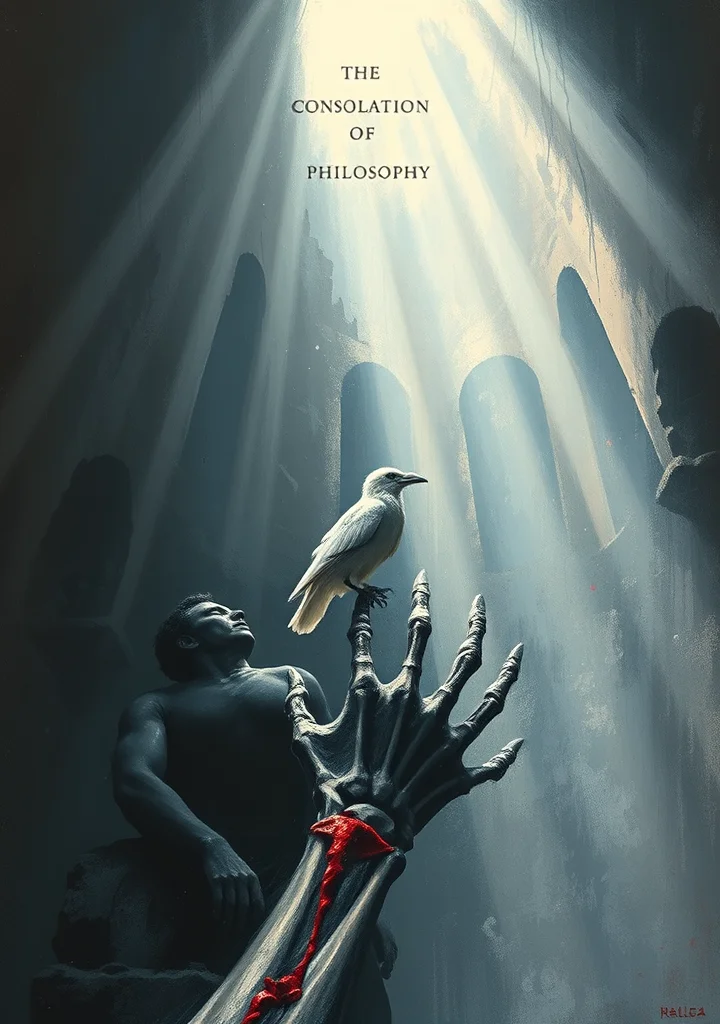
Dust motes dance in the fractured light of a crumbling tower, mirroring the fragments of a life shattered by exile and betrayal. Within these stone walls, a man—once a pillar of power, now stripped bare—grapples not with chains or bars, but with a grief that threatens to swallow him whole. He is haunted by the swift, cruel fall from grace, the whispers of accusations echoing in the hollows of his despair. But solace, or a twisted mockery of it, comes in the form of a spectral presence—Philosophy herself, a woman woven from starlight and sorrow, her voice a chilling balm against the wounds of the world. She leads him through labyrinthine corridors of thought, where reason battles with the phantom pain of loss. The air is thick with the scent of decay, both of the body politic and the soul. Visions of fortune’s wheel—a cruel, spinning device—loom large, showcasing the ephemeral nature of earthly power. Each argument, each carefully constructed verse, feels less like a comforting embrace and more like the cold touch of inevitability. The narrative is steeped in the grey of twilight, a perpetual autumn where every leaf falling is a reminder of what is lost. It is a meditation on the nature of good and evil, not as grand battles, but as insidious erosion, a slow poisoning of the spirit. The reader is drawn into a claustrophobic space where the only escape is through the labyrinth of the mind, where the architecture of despair is both beautiful and terrifying. Ultimately, the question lingers: is this consolation a true refuge, or merely a gilded cage built around a broken heart?