
Seoul Shadows
  • 4
  • 0
  • 1
  • Read 4
  • 0
  • Part 1
Completed, First published Jun 04, 2026

The narrative traces the interwoven lives of the affluent Jeon family and their extensive circle of friends and associates in Seoul. These chapters depict a family celebrating anniversaries and anticipating reunions, revealing affectionate dynamics and playful banter amongst its members. Hints of underlying tensions and challenges to the Jeon legacy emerge alongside scenes of warmth and tradition. As characters navigate medical recoveries and romantic anticipation, the story subtly suggests that love, ambition, and long-held secrets will shape the family’s future. These early chapters offer a glimpse into a world defined by wealth, connection, and unspoken desires.
Copyright: All Rights Reserved
No person is allowed to use, redistribute, or modify your work in any form without your explicit permission.
Recommended for you

51 Part
A creeping dampness clings to the stone of Norland Park, mirroring the chill that settles upon the hearts of the Dashwood sisters as they are cast adrift by a callous inheritance. The shadows lengthen with each diminishing fortune, twisting the familiar landscapes of Devonshire into a labyrinth of unspoken anxieties. Though outwardly composed, Elinor’s measured restraint barely conceals a grief that blooms like winter roses—pale and thorn-sharp. Marianne’s passions, unrestrained and fever-bright, find echo in the brooding woods and the melancholy sighs of a decaying estate. The air itself is thick with the scent of decaying leaves and unshed tears. Every polite conversation, every carefully worded letter, carries the weight of unacknowledged desires and simmering resentments. A spectral silence hangs between the sisters, broken only by the rustling of secrets in the darkened corridors. The very gardens, once vibrant with summer blooms, now seem haunted by the ghosts of promises broken and futures stolen. A subtle rot pervades the narrative—not of decay in the physical world, but in the very fabric of social grace. The polite smiles mask a desperate hunger for security, a fragile vulnerability masked by lace and propriety. The whispers of scandal, the stifled accusations, weave through the manor houses like tendrils of ivy, threatening to strangle the fragile hopes of these women in a world where sensibility is a weakness, and sense, a carefully constructed fortress against ruin. The fog-laden moors become a mirror for the fractured souls trapped within, their destinies shrouded in an atmospheric gloom that clings long after the final, desperate reckoning.
37 Part
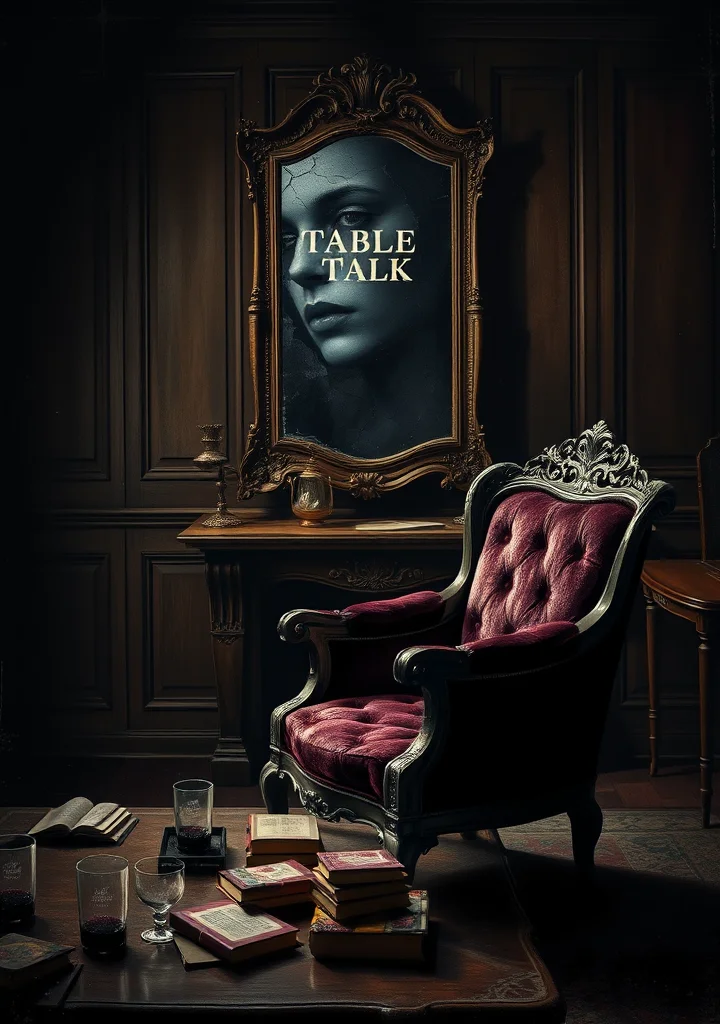
Dust motes dance in the perpetual twilight of shadowed parlors, mirroring the fractured reflections within Hazlitt’s prose. *Table-Talk* isn’t merely conversation; it is the exhumation of ghosts—not those of the dead, but of ideas, regrets, and the slow, corrosive decay of London society. Each essay, a chipped shard of a broken looking-glass, reveals a distorted portrait of the age, haunted by the specter of its own vanities. The voice is brittle, intimate, as if overheard through a crack in the wall, a feverish monologue delivered in the gloom. There’s a pervasive chill—not of winter, but of disillusionment—that seeps into the marrow of the sentences. The author dissects, not with surgical precision, but with the casual cruelty of a man tracing the lines of a skull. He lingers over the grotesque, the absurd, the moments where public spectacle curdles into private despair. A sense of claustrophobia clings to the pages; the air thick with the scent of stale tobacco and forgotten grievances. The narrative is less a journey than a slow unraveling—a descent into the labyrinth of the author’s own melancholic temperament. One feels the weight of unspoken histories, the oppressive silence of unacknowledged debts. It’s a book for those who find comfort not in illumination, but in the shadowed corners of the world, where the whispers of the past cling to the velvet curtains and the cobwebs of the mind. The final impression is one of being left alone in a decaying library, surrounded by the ghosts of conversations long since ended, and the haunting realization that every table has its own secret, and every voice, its own void.
41 Part
A creeping dread clings to the shadowed corners of Blackwood Manor, where Miss Mole, a woman steeped in quiet desperation, arrives as governess. The air is thick with unspoken histories, the very stones breathing with the weight of generations past. She finds herself not merely employed, but *absorbed* into the decaying grandeur, a fragile moth drawn to a flickering, dangerous flame. The manor’s isolation isn’t merely geographical; it’s a severance from the living world, a slow suffocation within velvet curtains and dust-motes dancing in perpetual twilight. Her charge, a pale child haunted by whispers, mirrors the manor’s own decaying beauty, and Miss Mole’s attempts to nurture life feel less like kindness and more like a futile struggle against the encroaching rot. The scent of jasmine and decay intertwine, mirroring the insidious blossoming of a love born from loneliness, a connection forged in the oppressive silence. But beneath the surface of polite society and veiled affections lurks a chilling awareness – a sense of being watched, not by prying eyes, but by the very fabric of the house itself. Every shadow holds a secret, every smile a carefully constructed facade, and Miss Mole discovers that Blackwood Manor doesn’t just *contain* secrets; it *feeds* on them, drawing its sustenance from the fractured souls within its walls. The narrative unravels like a moth-eaten tapestry, revealing a tapestry of obsession, loss, and a haunting question: will Miss Mole escape Blackwood’s embrace, or become another ghostly echo within its shadowed halls?