
Decline and Fall
  • 150
  • 0
  • 32
  • Reads 150
  • 0
  • Part 32
Completed, First published Mar 02, 2026

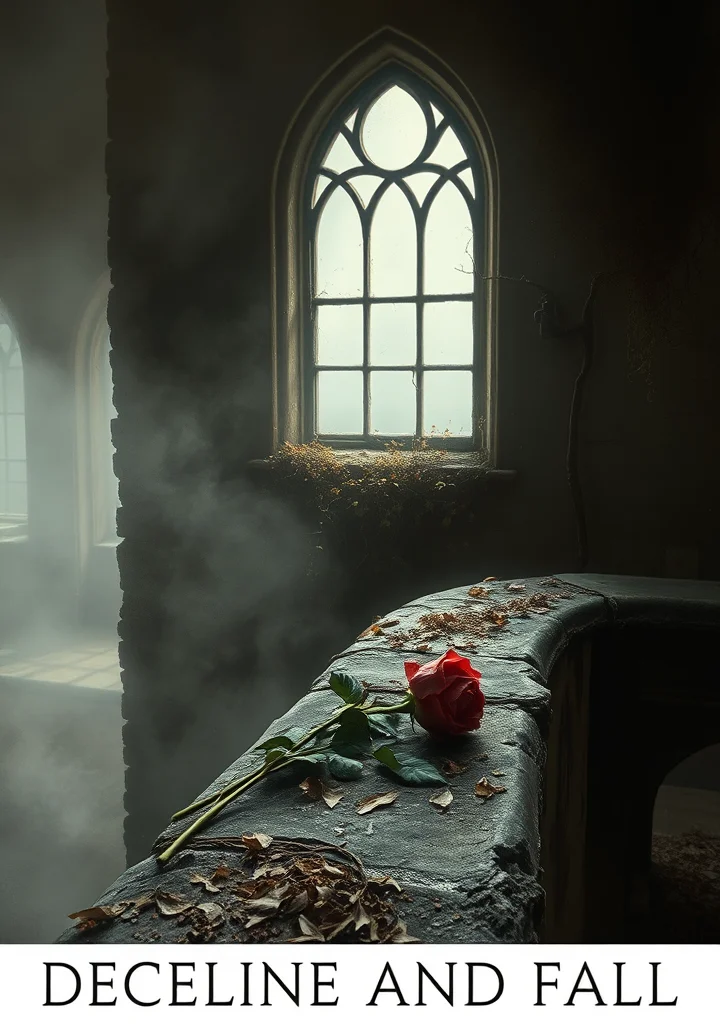
Dust motes dance in the echoing halls of High Hall, a crumbling testament to faith and ambition. The chill of Lincolnshire fens seeps into the very stones, mirroring the creeping desolation within young Charles Ryder’s heart. This is not a tale of grand battles or heroic deeds, but of a slow erosion – of innocence, of belief, of an entire lineage. The narrative clings to the decaying grandeur like ivy to a tomb, each chapter a shadowed alcove revealing fragments of a lost world. The air thickens with the scent of damp earth, beeswax polish, and the unspoken grief of generations. A suffocating beauty permeates every encounter, a gilded cage holding the promise of solace and the inevitable weight of decay. The novel’s true horror isn’t found in outright malice, but in the quiet, insidious unraveling of a man’s spirit as he witnesses the rot consuming the foundations of everything he once held sacred. The very light seems to dim with each passing year, leaving only the skeletal remains of hope in a perpetual twilight. It is a descent into a melancholic landscape where the only certainty is the final, inexorable fall.

Copyright: Public Domain
This license allows anyone to use your story for any purpose, including printing, selling, or adapting it into a film freely.
Recommended for you
32 Part
A perpetual twilight clings to the shadowed corners of New Moon, a desolate, windswept inheritance haunted by whispers of misfortune. The orphaned Emily Byrd, a creature of wild imagination and fiery spirit, arrives to claim her legacy—a decaying ancestral home steeped in the lore of a cursed lineage. But the house breathes with a sorrow that seeps into Emily's very soul, mirroring the spectral grief of her mother, a phantom presence woven into the very fabric of the moors. The narrative unfolds as a slow, melancholic descent into a world where dreams and realities blur, where the scent of heather and brine mingles with the bitterness of forgotten promises. Each chamber of New Moon holds a fragment of the past—a tarnished mirror reflecting a forgotten face, a faded portrait hinting at a tragic fate, a diary bound in leather stained with tears. Emily’s burgeoning poetic gifts become a conduit to the unseen, drawing her closer to the secrets buried within the family’s history. She is watched over by the silent, watchful eyes of the old servants, their faces etched with the weight of generations past. But the beauty of the landscape is deceptive, for the moor itself seems to possess a hungry darkness, a longing to reclaim what was lost. As Emily’s heart blossoms with both love and loss, she finds herself entangled in a web of family secrets, shadowed by the looming possibility that she too is destined to be consumed by the curse of New Moon. The novel is a slow burn, a haunting exploration of loneliness, resilience, and the enduring power of memory—a place where the boundary between life and death feels fragile as a moonbeam on a stormy sea.
148 Part
A world steeped in the mud and iron of the Thirty Years’ War bleeds into every page. Simplicissimus doesn't merely recount adventure; it exhumes it from the rotting timbers of abandoned villages and the hollow stares of famine’s ghosts. The narrative coils around you like a creeping fog, thick with the stench of gunpowder and the sour tang of desperation. It isn't heroism that echoes through these chapters, but a brutal, animalistic survival. Each encounter – a brawl in a mercenary camp, a desperate plea for shelter, a glimpse of skeletal families huddled around dying embers – is rendered with a chilling immediacy. The prose itself feels like a shard of glass pressed against the skin, sharp and unforgiving. Grimmelshausen doesn't offer escape, but immersion. You walk alongside Simplicissimus through landscapes ravaged not by armies alone, but by a spiritual decay that festers in the hearts of men. The castles loom as skeletal frameworks against bruised skies, and the forests whisper with the cries of the lost. The novel’s relentless forward motion mirrors the descent into madness, the erosion of innocence, and the ultimate realization that even in the deepest darkness, humanity finds a way to both inflict and endure. A suffocating claustrophobia settles over the reader as the narrative descends into a labyrinth of moral compromise and the casual horrors of a world utterly consumed by war. It is a world where the only virtue is the will to survive, and even that is often purchased with pieces of the soul.